
TPU vs. Chenvix SkinTouch: Why More Wearable Device Manufacturers Are Rethinking Their Overmolding Materials
- Nick Ye
- Jul 1
- 5 min read

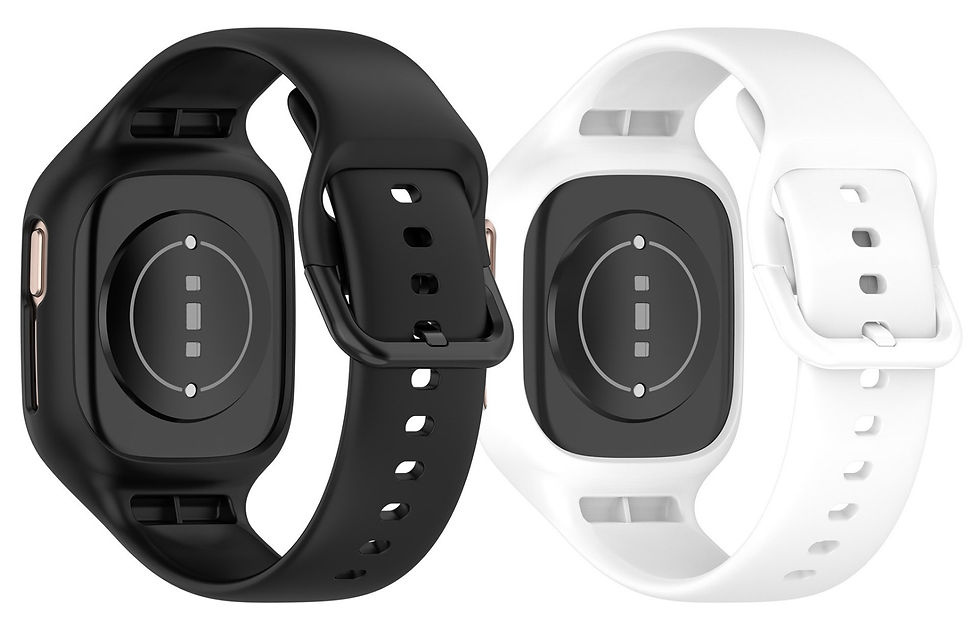
For more than a decade, TPU (Thermoplastic Polyurethane) has been one of the most widely used materials for smartwatch straps, children’s smartwatches, fitness bands, and many consumer electronic products.
TPU is a mature engineering material known for its excellent abrasion resistance, flexibility, and ease of processing, making it a popular choice across the industry.
However, when products require overmolding with rigid engineering plastics such as PC, ABS, or PA, manufacturers often discover that achieving consistent, high-quality production is more challenging than expected.
Recently, we worked with a leading children’s smartwatch manufacturer on a material upgrade project that perfectly illustrates these challenges.
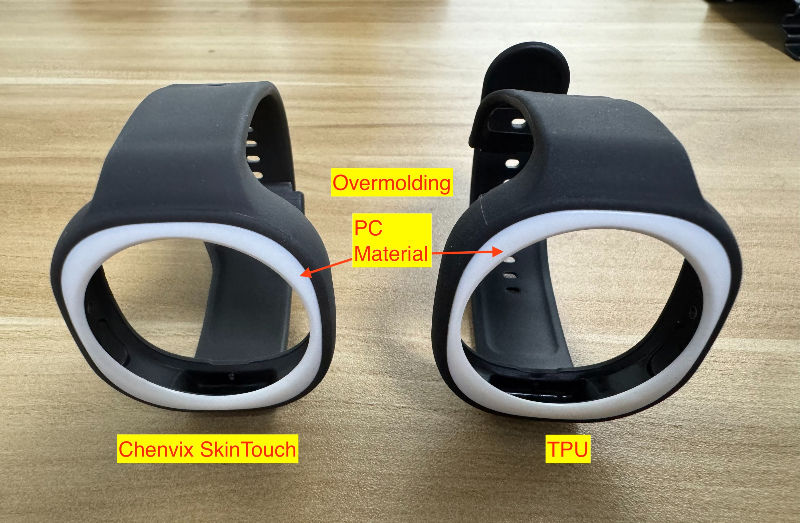
The customer had been using a high-performance TPU overmolded onto a PC substrate.
It is important to note that TPU is not a single material. Instead, it is a large family of materials with numerous formulations, including polyester- and polyether-based grades, various hardness levels, and specialized modifications. Performance and pricing vary significantly across different TPU grades.
The TPU used by our customer was already a premium grade, with a material cost comparable to Chenvix SkinTouch. Therefore, this comparison is not between low-cost TPU and SkinTouch, but between high-performance TPU and Chenvix SkinTouch.

Why Isn’t TPU Overmolding on PC as Simple as It Seems?
From a material compatibility standpoint, TPU and PC are chemically compatible and can form intermolecular hydrogen bonding. This is why TPU + PC has become a common combination in applications such as phone cases, power tool handles, protective eyewear, and electronic housings.
However, being a mature process does not necessarily mean it is an easy one to manufacture consistently.
In mass production, engineers often face several process challenges that directly impact production yield, product reliability, and manufacturing costs.
1. Stress Cracking in PC
One of the most common—and often overlooked—issues is stress cracking in polycarbonate (PC).
During the first injection molding process, residual internal stress remains within the PC component.
When TPU is injected during the second molding process, additives, plasticizers, together with long-term thermal cycling, may gradually release this stress.
As a result, products that initially pass inspection may develop problems weeks later during transportation, warehouse storage, or normal customer use, including:
Hairline cracks around the overmolded area
Cracking of the PC substrate
Fracture at the bonding interface
Surface whitening
To minimize this risk, many manufacturers add an additional annealing process:
Anneal the PC part at approximately 120°C for 2–4 hours
Release residual internal stress before overmolding
Although this significantly reduces the risk of cracking, it also means:
Additional production steps
More equipment
Longer production cycles
Higher manufacturing costs
2. Different Thermal Expansion and Shrinkage Rates
TPU is a flexible material.
PC is a rigid engineering plastic.
Because these two materials have very different coefficients of thermal expansion and shrinkage, the bonding interface is constantly subjected to stress during temperature changes.
For example:
Hot summer environments
Cold winter conditions
Daily temperature fluctuations during normal use
If the product relies solely on chemical adhesion, long-term use may eventually result in:
Edge lifting
Delamination
Loosened overmolded areas
To improve durability, mold designers often incorporate mechanical locking features such as:
Undercuts
Textured bonding surfaces
Mechanical interlocking structures
These features help reinforce the bond instead of relying solely on material adhesion.
3. Strict Drying Requirements
Both TPU and PC are hygroscopic materials that readily absorb moisture from the air.
If moisture is not properly removed before molding, the injection process may produce:
Air bubbles
Silver streaks
Delamination
Reduced bonding strength
Typical drying conditions include:
PC
120°C for 4–6 hours
TPU
80–90°C for 2–3 hours
Failure to properly dry either material can significantly reduce bond strength and overall product quality.
For high-volume manufacturing, maintaining this level of process control requires strict production management.
4. Narrow Processing Window
The TPU overmolding process is highly sensitive to molding parameters.
For example:
If mold temperature is too low:
Insufficient fusion occurs, resulting in weak bonding.
If TPU melt temperature is too high:
The PC surface may become damaged, increasing the risk of future cracking.
As a result, manufacturers typically spend considerable time optimizing:
Mold temperature
Injection temperature
Holding pressure
Cooling time
Only after repeated adjustments can a stable production process be established.
This is one reason why identical molds often produce very different yields at different factories.
How Does Chenvix SkinTouch Address These Challenges?
Chenvix SkinTouch was not developed simply to replace TPU.
It was engineered to simplify the overmolding process while improving manufacturing consistency, production efficiency, and long-term product reliability.
Through optimized material formulation, SkinTouch achieves outstanding bonding performance with engineering plastics such as PC, ABS, and other rigid substrates.
Compared with conventional TPU, SkinTouch offers several significant manufacturing advantages.
Note:The video above showcases the bonding performance of Chenvix SkinTouch using an existing phone case mold. The transparent part is PC (polycarbonate), and the black part is Chenvix SkinTouch. Even without any surface treatment, primers, or adhesives—and with only a very narrow bonding area along the edge—the two-shot overmolded parts exhibit outstanding bond strength, demonstrating the excellent adhesion between Chenvix SkinTouch and PC.
Stronger Bonding Performance
SkinTouch forms a robust and durable bond with PC, ABS, and other engineering plastics.
Under standard molding conditions, no additional primers, adhesives, or complex surface treatments are required to achieve excellent adhesion.
Even after repeated bending, stretching, or long-term use, the bonding interface remains secure without delamination or tearing.
For products such as smartwatches, children’s smartwatches, and wearable electronics that experience constant mechanical stress, this translates into improved long-term durability.
A Wider Processing Window
Compared with TPU, SkinTouch provides a much more forgiving processing window.
This means manufacturers can benefit from:
Easier mold setup
Faster process optimization
More consistent product quality
Ultimately, this reduces machine setup time while improving production efficiency.
Simplified Manufacturing
Because SkinTouch naturally exhibits excellent adhesion to rigid plastics, manufacturers can often eliminate several additional processing steps.
In many applications, there is no need for:
Adhesives
Primers
Complex surface preparation
A simpler production process helps reduce manufacturing costs while improving productivity.
Improved Long-Term Reliability
Initial bonding strength is only part of the equation.
Long-term durability is equally important.
After repeated thermal cycling, continuous bending, and prolonged daily use, SkinTouch maintains a stable bond with rigid plastics without experiencing:
Edge lifting
Delamination
Tearing
Bond failure
For consumer electronics manufacturers, this means longer product life and a better user experience.
TPU vs. Chenvix SkinTouch Comparison
Feature | TPU | Chenvix SkinTouch |
Bonding to PC | Achievable but requires tight process control | Strong and stable bonding |
Processing Window | Relatively narrow | Wider and more forgiving |
Process Sensitivity | High | Lower |
Production Yield Control | More difficult | Easier to stabilize |
Risk of Stress Cracking | Requires careful control | Lower risk |
Thermal Cycling Performance | Depends heavily on design and process | More stable bonding interface |
Bonding to ABS | Achievable | Excellent bonding performance |
Production Efficiency | Longer setup and optimization | Faster path to mass production |
Conclusion
TPU remains an excellent and widely used engineering material for wearable electronics and consumer products.
However, as manufacturers place increasing emphasis on production efficiency, yield, and long-term reliability, simply achieving successful overmolding is no longer enough.
Reducing process complexity, minimizing production risks, and improving manufacturing consistency have become equally important considerations when selecting materials.
Chenvix SkinTouch was developed with these objectives in mind.
In addition to delivering a premium silicone-like soft touch, it provides outstanding bonding performance with PC, ABS, and other engineering plastics, helping manufacturers simplify production while improving product quality and long-term durability.
Whether you’re developing smartwatch bands, wearable electronics, consumer products, or premium overmolded components, Chenvix SkinTouch offers a more efficient and reliable manufacturing solution.
Related Articles


Comments